A smooth powder-coated surface depends on more than resin, pigment and curing temperature. Gases trapped inside the molten coating must also escape before the film fully cures.
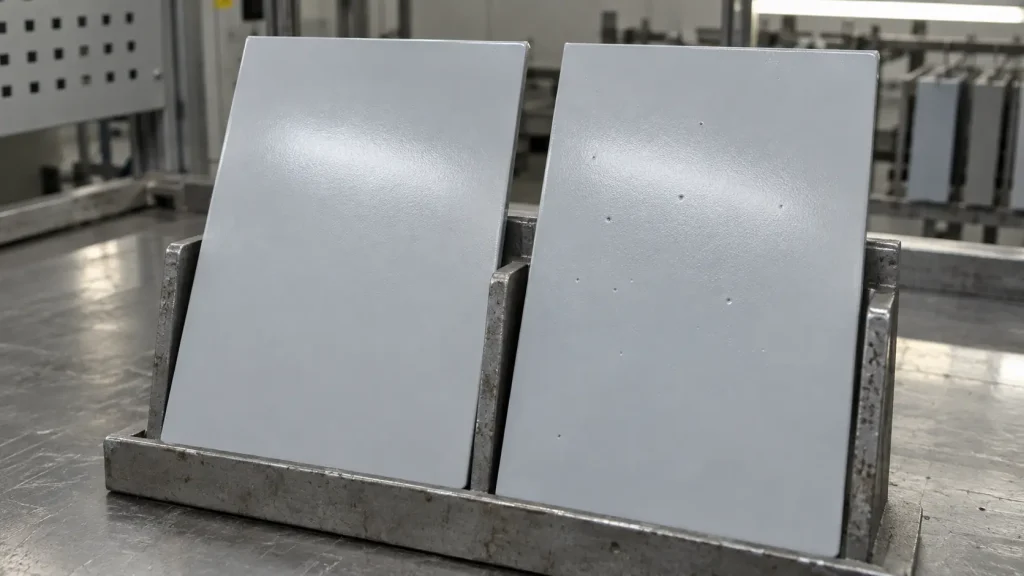
If they remain inside the coating, small bubbles, pinholes and other surface defects may appear. This is why degassing additives are included in many powder-coating formulations.
Benzoin is one of the traditional materials used for this purpose. It can support the release of trapped gases during the melting and curing stages, helping formulators achieve a smoother and more consistent coating surface.
However, benzoin is not a universal solution for every surface defect. Its performance depends on the complete formulation, processing conditions and quality of the material itself.
What Is Benzoin?
Benzoin is an organic compound commonly identified by CAS No. 119-53-9. It is generally supplied as a white to off-white crystalline material and is used in powder coatings, fine chemical synthesis and other industrial applications.
The benzoin used in powder coatings is a defined chemical compound. It should not be confused with benzoin resin, which is a natural plant resin obtained from trees of the Styrax family.
Because both materials are called “benzoin” in English, buyers should always confirm the CAS number, specification and intended application before placing an order.
Why Do Pinholes Form in Powder Coatings?
During powder coating, the applied powder is heated until it melts, flows and forms a continuous film. The coating then cures to create the final surface.
While the film is molten, air, moisture and other volatile materials may be released from the powder, substrate or curing reaction. These gases need enough time to move through the liquid coating and escape.
If the surface begins to cure before the gases are released, bubbles may remain inside the film or break through the surface. This can result in pinholes, craters or an uneven appearance.
The problem may become more noticeable when the coating is applied at a greater film thickness or when the substrate contains moisture or trapped air.
How Does Benzoin Support Degassing?
Benzoin is commonly used as a degassing additive because it helps trapped gases escape while the powder coating is melting and flowing.
Its role is not simply to remove gas after a defect has formed. It supports the coating during the short processing window before the film becomes fully cured.
When properly incorporated into a suitable formulation, benzoin may help reduce pinholes and improve surface smoothness. This can be especially important when coating porous substrates, producing thicker films or working with formulations that generate volatile materials during curing.
Good dispersion is essential. If benzoin is not distributed evenly throughout the powder, its effect may also be uneven across the finished coating.
Why Benzoin Cannot Solve Every Surface Defect
Not every pinhole is caused by insufficient degassing. Similar defects may result from substrate contamination, moisture, poor pretreatment, incompatible additives or unsuitable curing conditions.
Before changing the level of benzoin, formulators should examine the entire coating process, including:
- Resin and curing-agent compatibility
- Substrate cleanliness and moisture
- Powder dispersion and extrusion conditions
- Applied film thickness
- Heating rate and curing schedule
- Pigments, fillers and other additives
Adding more benzoin will not necessarily correct a problem caused elsewhere in the process. Excessive use may introduce new concerns instead of improving the coating.
Laboratory testing should therefore compare different formulations under the same application and curing conditions.
Special Considerations for White and Clear Coatings
Color is an important consideration when benzoin is used in white, pale or transparent powder coatings.
Benzoin may contribute to yellowing or affect clarity under some formulation and curing conditions. These changes may be less noticeable in dark or highly pigmented coatings but more visible in white and clear systems.
This does not mean benzoin is unsuitable for all light-colored coatings. It means that the complete formulation should be tested before commercial production.
Formulators should evaluate the cured panel rather than relying only on the appearance of the raw powder. Color, transparency, gloss and surface smoothness should be checked after the intended curing cycle and, where necessary, after accelerated aging.
What Should Buyers Check When Purchasing Benzoin?
For powder-coating manufacturers, a low quotation alone does not confirm whether benzoin is suitable for production.
The supplied material should match the agreed chemical identity and specification. Buyers may need to evaluate appearance, assay, melting range, particle size, moisture and other relevant quality attributes.
Particle size can influence blending and dispersion, while variations in color may be more important for white or transparent coatings. Packaging should protect the material from contamination and unsuitable storage conditions.
A representative sample should be tested in the customer’s actual resin, pigment and curing system. After sample approval, comparing the first commercial batch with the approved sample can provide additional confidence before regular purchasing begins.
Batch traceability and consistent technical documents are also important. The product label, Certificate of Analysis and shipment information should refer to the same batch.
Application Testing Matters More Than a Standard Dosage
There is no single benzoin level that is automatically suitable for every powder-coating formulation.
The appropriate amount depends on the resin system, curing chemistry, pigment package, substrate, film thickness and required appearance. A level that performs well in a dark industrial coating may not provide the same result in a high-gloss white or clear coating.
For this reason, suppliers should avoid recommending one fixed dosage without understanding the customer’s application.
A better approach is to begin with controlled laboratory trials, compare coated panels and adjust the formulation according to the actual results.
Final Thoughts
Benzoin remains a practical degassing additive for many powder-coating systems. Its main value is helping gases escape during melting and curing, which can reduce pinholes and support a smoother coating surface.
Its performance, however, must be evaluated as part of the complete formulation. Resin compatibility, dispersion, substrate condition, film thickness, curing parameters and color requirements all influence the final result.
At Cixiang Pharmtech, we supply benzoin and other related fine chemical products for international customers. Buyers are welcome to share their target specification, application, packaging requirements and testing concerns before requesting a sample.
Clear technical communication and representative application testing can help both sides determine whether the material is suitable before moving to bulk purchasing.