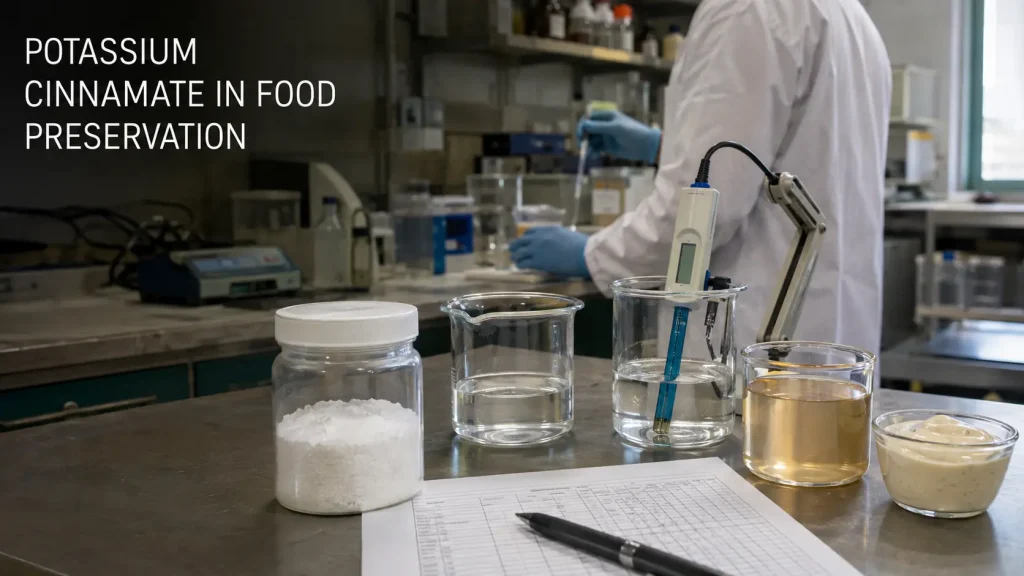
As food manufacturers explore different ingredient systems for product preservation, potassium cinnamate has attracted attention because of its relationship to cinnamic acid and its compatibility with water-based processing.
However, selecting an ingredient is only the first step. Its actual performance in a food formulation may be influenced by pH, concentration, processing conditions and interactions with other ingredients. Before commercial use, formulators need to understand how potassium cinnamate behaves in their specific product rather than relying only on a standard recommended dosage.
What Is Potassium Cinnamate?
Potassium cinnamate is the potassium salt of cinnamic acid. Its chemical identity is commonly associated with CAS No. 16089-48-8.
Compared with cinnamic acid, the potassium salt form is generally more convenient for incorporation into water-based systems. This can make weighing, pre-dissolving and distribution easier during production.
However, good water compatibility does not mean that it will behave identically in every formulation. Temperature, product concentration, mineral content, acidity and the order of addition may all affect dissolution and stability.
For this reason, the product should be evaluated under conditions that closely reflect actual manufacturing.
Why Formulation pH Matters
Potassium cinnamate belongs to an organic acid salt system. When it is added to a formulation, its chemical form and behavior may change according to the surrounding pH.
The final pH can influence:
- Solubility and clarity
- Distribution throughout the product
- Interaction with other ingredients
- Sensory characteristics
- Overall preservation performance
In an acidic formulation, part of the cinnamate may convert to cinnamic acid. If the formulation conditions are not properly controlled, changes in clarity or precipitation may occur.
Formulators should therefore avoid evaluating potassium cinnamate in water alone. Testing should be completed in the finished formulation or in a representative laboratory model with a similar pH and ingredient composition.
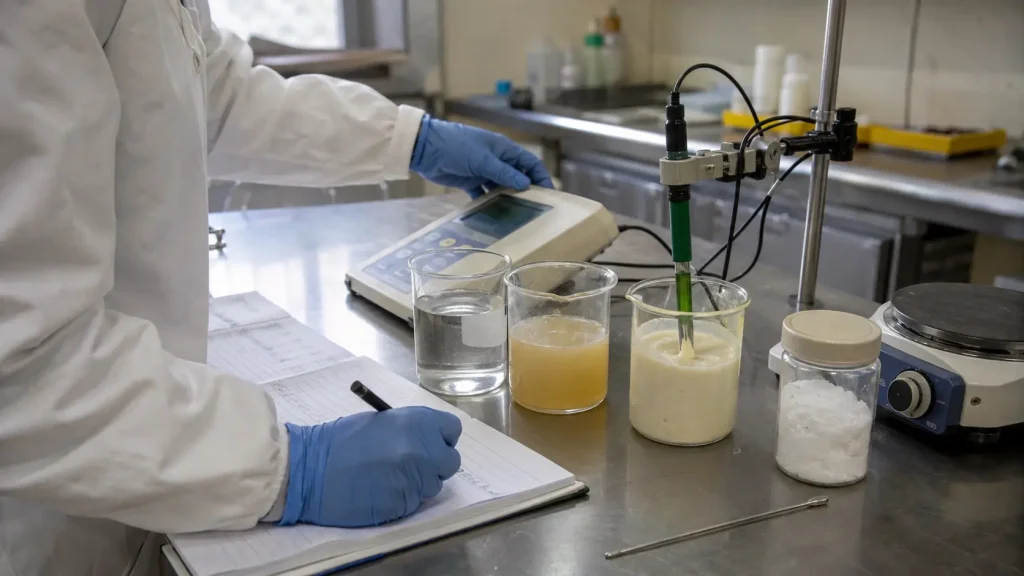
Dissolution and Addition Method
The method of addition may influence how evenly potassium cinnamate is distributed.
In many applications, preparing a pre-dissolved solution can be more effective than adding the powder directly to a complex food mixture. The material should be introduced gradually with suitable mixing, while the temperature and final pH are monitored.
The best procedure depends on the formulation. A clear beverage, a sauce, a bakery filling and an emulsified product may require different addition methods.
Other ingredients may also affect performance. High concentrations of sugar, salt, minerals, proteins or acids can change the surrounding environment and influence product clarity or stability.
A successful laboratory solution does not automatically guarantee the same result in the final food system.
Application Testing Is Essential
Potassium cinnamate should not be treated as a universal solution that performs equally in every food product.
Before commercial production, manufacturers should conduct small-scale formulation testing and evaluate the product throughout the intended shelf-life period.
Important observations may include:
- Final product pH
- Dissolution and distribution
- Appearance, color and clarity
- Aroma and taste
- Stability during processing and storage
- Compatibility with packaging and other ingredients
If preservation is the intended function, suitable microbiological testing should also be completed. A qualified laboratory may use challenge testing or another appropriate evaluation method to determine whether the complete preservation system performs reliably under expected storage conditions.
Preservation should be assessed as part of the entire formulation. Product hygiene, water activity, heat treatment, packaging and storage temperature may be just as important as the selected ingredient.
What Overseas Buyers Should Confirm
When sourcing potassium cinnamate, overseas customers should compare more than the quoted price.
The supplier should provide clear product identification, specification, a representative Certificate of Analysis and an SDS. Buyers may also need to confirm assay, appearance, moisture control, packaging, batch traceability and storage recommendations.
The sample used for testing should represent normal commercial production. Once the sample is approved, a trial order can help confirm whether the commercial batch provides comparable quality, packaging and application performance.
Buyers should also inform the supplier of the target market and intended application. Food-additive rules, permitted uses, dosage requirements and labeling obligations can differ between countries and product categories.
Regulatory suitability should therefore be verified for each destination market before commercial use.
Final Thoughts
Potassium cinnamate offers useful formulation possibilities, but successful application depends on more than simply adding it to a recipe.
Its solubility, pH response, addition method, ingredient compatibility and sensory influence should all be evaluated in the actual food system. When preservation is the objective, microbiological validation and shelf-life testing are essential.
At Cixiang Pharmtech, we welcome customers to share their target market, intended application, product specification and testing requirements before requesting a sample. Clear technical communication at the beginning can help customers evaluate product suitability more efficiently and reduce uncertainty before bulk purchasing.