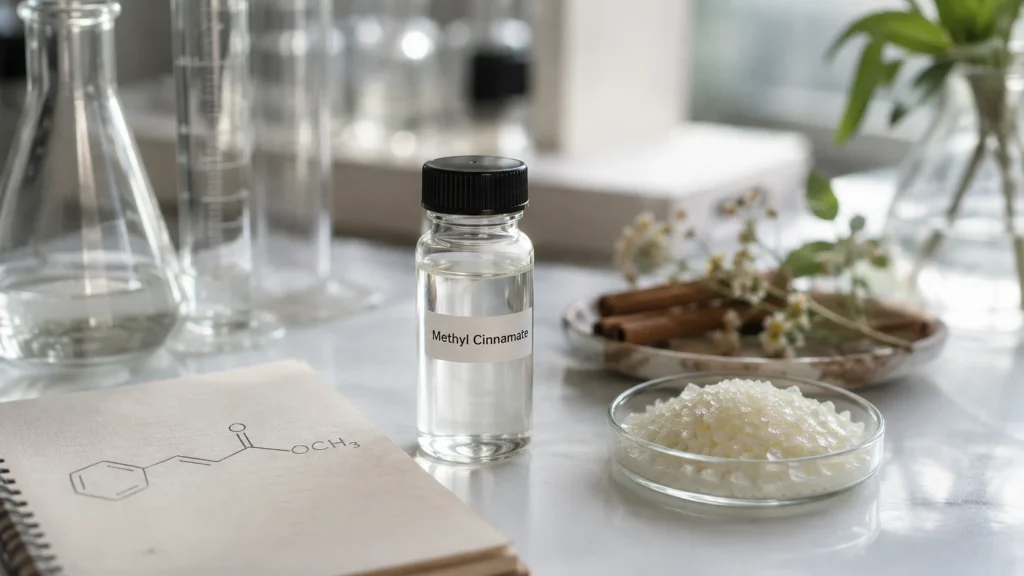
Some aroma chemicals are easy to remember because their names sound familiar. Others are remembered because of the feeling they create. Methyl Cinnamate belongs to the second group.
It is an ester of cinnamic acid, known for its sweet, fruity, balsamic, and slightly spicy aroma. To many fragrance and flavor professionals, Methyl Cinnamate is not just a “nice-smelling ingredient.” It is a useful material that can bring softness, warmth, sweetness, and depth to different formulations.
At the same time, Methyl Cinnamate is also part of the broader cinnamic series product family. This makes it interesting not only for fragrance and flavor applications, but also for fine chemical and industrial users who pay attention to stable supply, consistent quality, and reliable raw material sourcing.
1. What Is Methyl Cinnamate?
Methyl Cinnamate is an organic ester formed from cinnamic acid and methanol. Its CAS number is 103-26-4, and its molecular formula is C10H10O2.
In simple terms, it belongs to the cinnamate ester family. This family is known for warm, sweet, fruity, balsamic, and floral odor characteristics. Among them, Methyl Cinnamate is one of the classic representatives.
Depending on purity, storage conditions, and product form, Methyl Cinnamate may appear as a white to pale yellow crystalline solid or a light-colored material. It has a pleasant aroma that is often described as sweet, fruity, strawberry-like, balsamic, and slightly spicy.
If cinnamaldehyde is bold and recognizable, Methyl Cinnamate is softer and more rounded. It does not always shout in a formulation, but it can quietly make the final product feel smoother and more complete.
2. What Does Methyl Cinnamate Smell Like?
The odor of Methyl Cinnamate is one of the reasons it is widely discussed in fragrance and flavor applications.
Its scent is commonly described as sweet, fruity, balsamic, floral, and slightly spicy. Some people associate it with strawberry, cherry, grape, or tropical fruit notes. Others may notice a warm balsamic background that connects it with cinnamon-like or resinous directions.
This kind of odor profile gives formulators flexibility. Methyl Cinnamate can support fruity accords, add sweetness to floral compositions, and bring a gentle warm background to fragrance systems.
It is not usually the loudest ingredient in the room. Instead, it works more like good background music. You may not always notice it immediately, but the whole atmosphere feels better when it is there.
3. Methyl Cinnamate in Fragrance Applications
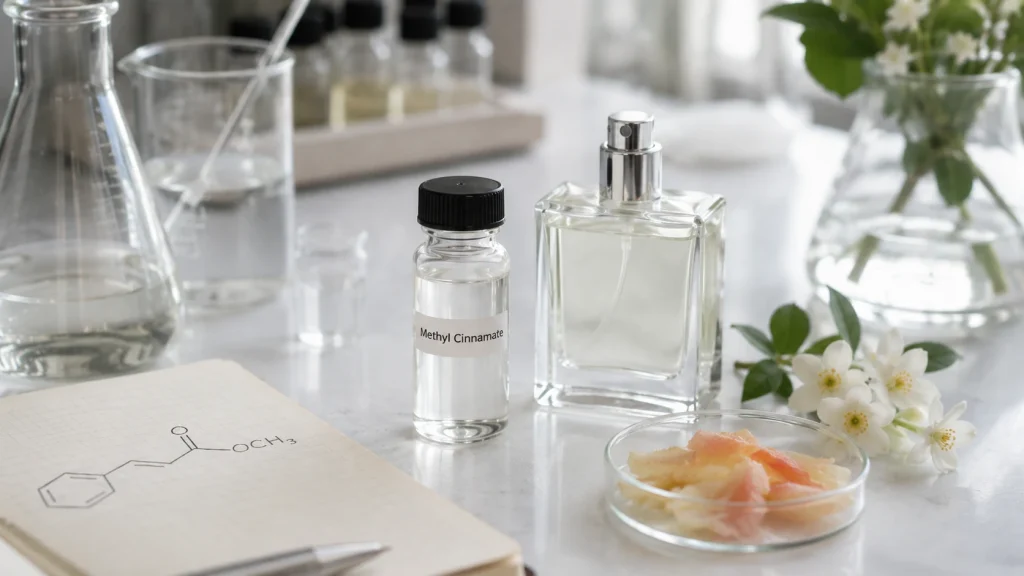
In fragrance creation, small materials often have a big impact. Methyl Cinnamate can be used to support fruity, floral, balsamic, spicy, and oriental-type fragrance directions.
It may help soften a formula, improve sweetness, and add a warm fruity nuance. In floral compositions, it can bring a delicate sweetness. In fruity concepts, it can enhance berry-like or tropical fruit impressions. In warm and balsamic fragrances, it can contribute depth and smoothness.
This makes it useful in personal care fragrances, fine fragrances, household products, air care, and other scented consumer products, depending on the formulation and regulatory requirements.
For fragrance manufacturers, the important point is consistency. A material with a pleasant odor is only useful when the odor remains stable from batch to batch. This is why product quality, odor evaluation, and supply reliability matter so much.
4. Methyl Cinnamate in Flavor-Related Applications
Methyl Cinnamate is also known in flavor-related contexts because of its sweet and fruity character. It may be used to support strawberry, cherry, grape, fruit, spice, and balsamic flavor directions.
Its profile can help create a warm and rounded sweetness, especially in flavor systems that require fruity or aromatic depth.
However, flavor applications always require careful attention to regulations. Different countries and regions may have different rules for permitted use, usage levels, documentation, and final product categories. Before using Methyl Cinnamate in any food or flavor application, customers should confirm compliance with the target market and the final product requirements.
In other words, Methyl Cinnamate may smell friendly, but regulatory work still needs to be serious.
5. Why It Belongs to the Cinnamic Series Family
Methyl Cinnamate is closely related to cinnamic acid, one of the core products in the cinnamic series. Through esterification, cinnamic acid can form different cinnamate esters, including methyl cinnamate, ethyl cinnamate, benzyl cinnamate, and others.
This connection makes Methyl Cinnamate part of a larger product network. The cinnamic series is widely used in aroma chemicals, fine chemicals, food ingredients, pharmaceutical intermediates, and industrial applications.
For customers, this matters because a supplier with experience in cinnamic series products may better understand the production logic, quality control points, and downstream application requirements of related materials.
Methyl Cinnamate is not an isolated product. It is one piece of a larger cinnamic series puzzle.
6. Fine Chemical and Industrial Value
Although Methyl Cinnamate is often introduced through its aroma, it also has value as a fine chemical material. Its ester structure and aromatic backbone make it useful in certain downstream synthesis and specialty chemical applications.
In fine chemical supply chains, products like Methyl Cinnamate are important because they can serve as intermediates, formulation ingredients, or functional raw materials depending on the user’s process.
For industrial buyers, what matters is not only whether the product matches the name on the purchase order. They need specifications, stability, documentation, packaging, delivery, and long-term supply support.
This is especially important when the material is used in production rather than only sample evaluation. A stable product helps customers reduce testing time, avoid unnecessary production adjustments, and maintain smoother operations.
7. What Should Buyers Pay Attention To?
When purchasing Methyl Cinnamate, buyers should look beyond price alone.
Important factors include appearance, assay, odor profile, color, impurity control, moisture, melting point, packaging, storage condition, and batch consistency. For fragrance and flavor-related applications, odor quality is especially important. For fine chemical applications, technical specifications and impurity control may become the key focus.
Storage also matters. Methyl Cinnamate should generally be stored in a cool, dry, well-ventilated place, away from excessive heat, strong light, and incompatible materials. Packaging should remain tightly closed when not in use.
A good supplier should be able to provide proper documentation such as specification sheets, safety data sheets, and other supporting documents required by customers or destination markets.
8. Why Stable Supply Matters
In the chemical industry, stable supply is often just as important as good quality.
A formulator may spend months adjusting a fragrance or flavor system. A manufacturer may build a production process around a specific raw material. If the material suddenly changes in quality or becomes difficult to obtain, the downstream impact can be significant.
That is why customers often prefer suppliers who can provide continuous production capability, consistent batches, clear communication, and responsive service.
For products like Methyl Cinnamate, which may be used across aroma and fine chemical fields, a reliable supply partner can make the sourcing process much easier.
9. Methyl Cinnamate and Cixiang Pharmtech
Zaoyang Cixiang Pharmtech focuses on cinnamic series products, aroma chemicals, and related fine chemical raw materials. Methyl Cinnamate fits naturally into this product direction because it is one of the important cinnamate ester products derived from the cinnamic series.
Together with cinnamaldehyde, cinnamic acid, cinnamyl alcohol, benzyl cinnamate, ethyl cinnamate, benzyl benzoate, benzyl alcohol, and other related materials, Methyl Cinnamate helps support customers in fragrance, flavor-related materials, fine chemicals, and industrial applications.
At Cixiang, we believe that a good chemical supplier should provide more than a product. Stable production, consistent quality, documentation support, practical communication, and long-term cooperation are all part of reliable supply.
10. Final Thoughts
Methyl Cinnamate is a small but charming member of the cinnamic series family.
Its sweet, fruity, balsamic, floral, and slightly spicy character makes it useful in fragrance and flavor-related applications. Its chemical structure also gives it value as a fine chemical material and downstream raw material.
It may not always be the loudest ingredient in a formula, but it can help create a warmer, smoother, and more rounded final impression.
For buyers, formulators, and manufacturers, understanding Methyl Cinnamate is not just about knowing its CAS number or odor description. It is about understanding how this material fits into real applications, quality control, and long-term supply planning.
In short, Methyl Cinnamate is one of those ingredients that quietly does its job — and does it well.