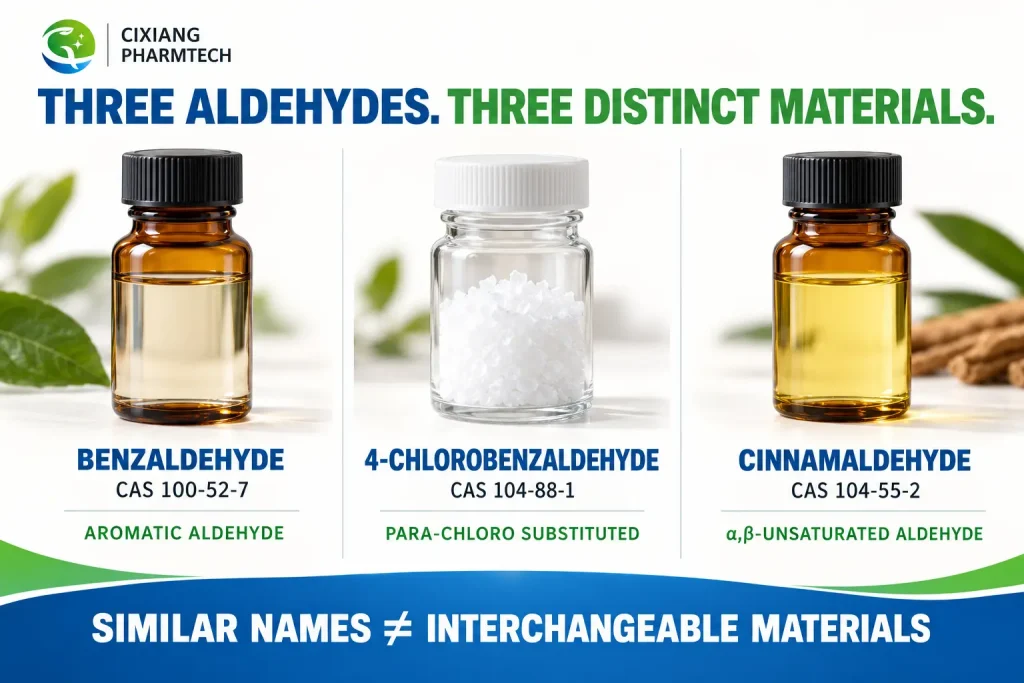
Benzaldehyde, 4-chlorobenzaldehyde and cinnamaldehyde all contain an aldehyde group and share some similarities in their names. On a purchase list, they may even appear to belong to the same simple product family.
From a chemical perspective, however, they are three distinct materials.
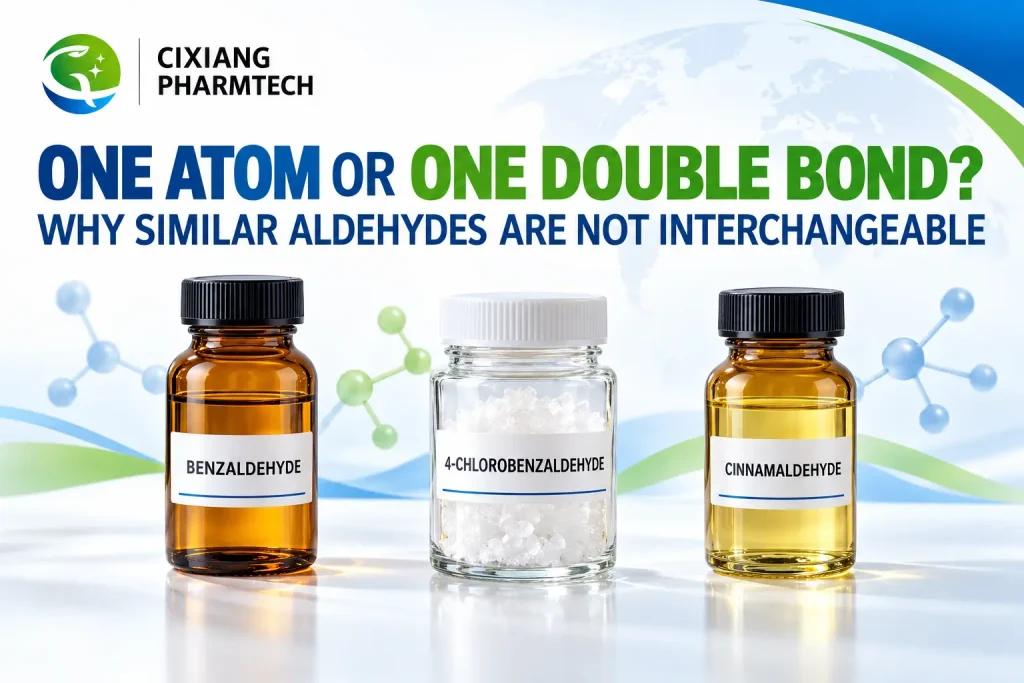
A chlorine atom on the aromatic ring or an additional carbon–carbon double bond changes the molecular structure, physical properties and reaction behaviour of the product. Choosing the wrong material can therefore affect an entire synthesis route—not just the name printed on the container.
Benzaldehyde: The Basic Aromatic Aldehyde
Benzaldehyde has the molecular structure C₆H₅CHO and CAS No. 100-52-7. Its aldehyde group is connected directly to a benzene ring.
This relatively simple structure makes benzaldehyde a widely used starting material and intermediate in organic synthesis. Depending on the process, it may participate in condensation, oxidation, reduction and carbon–carbon bond-forming reactions.
Commercial benzaldehyde is generally supplied as a liquid. When buyers evaluate the material, they may need to consider more than assay alone. Colour, acidity, moisture, related aromatic impurities and oxidation products can also influence its suitability for a particular process.
Because benzaldehyde can gradually oxidise when exposed to air, packaging integrity and appropriate storage conditions are important. The product should always be handled according to the supplier’s current SDS and the requirements of the intended application.
4-Chlorobenzaldehyde: One Chlorine Atom Changes the Material
4-Chlorobenzaldehyde, also known as p-chlorobenzaldehyde, has CAS No. 104-88-1. Its structure contains a chlorine atom at the para position of the benzene ring.
This may appear to be a small modification, but it changes both the physical and chemical characteristics of the product.
Unlike benzaldehyde, 4-chlorobenzaldehyde is commonly handled as a solid under normal commercial conditions. The chlorine substituent also changes the electronic environment of the aromatic ring and provides a structural feature that may be retained in downstream pharmaceutical, agrochemical or specialty-chemical intermediates.
For synthesis projects, the position of the chlorine atom is critical. The ortho, meta and para isomers are different compounds and should not be treated as equivalent materials.
A purchase order that states only “chlorobenzaldehyde” is therefore incomplete. Buyers should confirm:
- the full product name;
- the substitution position;
- the CAS number;
- the agreed assay and impurity limits;
- the required physical form;
- any application-specific requirements.
Even when two positional isomers have similar molecular weights, their melting behaviour, reactivity and downstream products may be different.
Cinnamaldehyde: The Double Bond Creates a Different Reaction System
Cinnamaldehyde has CAS No. 104-55-2 and the structure C₆H₅CH=CHCHO.
Compared with benzaldehyde, cinnamaldehyde contains an additional carbon–carbon double bond between the aromatic ring and the aldehyde group. This makes it an α,β-unsaturated aldehyde—a conjugated system with reaction behaviour that differs significantly from benzaldehyde.
In a synthesis route, reactions may involve:
- the aldehyde group;
- the carbon–carbon double bond;
- the complete conjugated system;
- selective transformation of one functional position while retaining another.
A process developed for benzaldehyde cannot automatically use cinnamaldehyde as a substitute. The additional double bond affects molecular geometry, reaction selectivity, possible by-products and the structure of the final derivative.
Cinnamaldehyde is also commonly supplied as a liquid, but its specification and impurity profile should be evaluated according to its own application. It should not be identified or approved only on the basis of a general description such as “aromatic aldehyde.”
A Quick Structural Comparison
| Product | CAS No. | Key structural feature | Common physical form |
|---|---|---|---|
| Benzaldehyde | 100-52-7 | Aldehyde group attached directly to a benzene ring | Liquid |
| 4-Chlorobenzaldehyde | 104-88-1 | Para chlorine substituent on the benzene ring | Solid |
| Cinnamaldehyde | 104-55-2 | Conjugated carbon–carbon double bond and aldehyde group | Liquid |
The physical form listed above is a general commercial description. Actual appearance and handling conditions should always be confirmed using the agreed specification and product-specific documentation.
Why Naming Errors Become Project Problems
A product-name error can occur at several stages:
- the enquiry uses an abbreviated or incomplete name;
- the quotation lists a product family instead of an exact compound;
- the purchase order omits the CAS number;
- the package label does not match the approved specification;
- a positional isomer is selected incorrectly;
- the receiving team checks only the quantity and ignores chemical identity.
These mistakes can lead to failed reactions, unexpected impurity profiles, additional purification, production delays or rejection of the finished batch.
The risk is especially high when several related aromatic chemicals are purchased from different suppliers or stored in the same warehouse.
What Buyers Should Confirm Before Ordering
Before approving a sample or bulk order, purchasing and technical teams should align the following information:
1. Exact chemical identity
Confirm the full name, CAS number and, when necessary, the structural formula. Avoid relying only on a shortened commercial name.
2. Substitution position
For substituted aromatic products such as chlorobenzaldehyde, confirm whether the material is the ortho, meta or para isomer.
3. Agreed specification
Review assay, appearance, moisture and relevant impurities. The most important parameters may differ according to the customer’s process.
4. Physical form and packaging
Confirm whether the product will be supplied as a liquid, solid, powder, flakes or another form. Packaging should be compatible with the product and transportation conditions.
5. Batch documents
The COA should correspond to the actual shipped batch. The product name, CAS number and batch number should remain consistent across the purchase order, label, COA, SDS and packing list.
6. Application testing
Where the material will be used in a sensitive reaction or formulation, evaluate a representative sample under actual process conditions before moving to bulk purchasing.
Final Thoughts
Benzaldehyde, 4-chlorobenzaldehyde and cinnamaldehyde demonstrate an important principle in chemical purchasing: similar names do not indicate interchangeable products.
One chlorine atom changes the identity and properties of the aromatic compound. One additional double bond creates a different reaction system. These structural details determine how the material behaves and where it fits within a synthesis route.
Reliable sourcing therefore begins with exact identification. Confirming the product name, CAS number, substitution position, specification and batch documentation can prevent a small naming mistake from becoming a costly production problem.
At Cixiang Pharmtech, we support customers with cinnamon-series products and selected aromatic chemical intermediates. If you are evaluating a material for sampling or bulk purchasing, please share the exact product identity, target specification, intended application and packaging requirements with our team.