
A shipment leaves the factory with clean packaging, complete documents and a product that meets specification. Several weeks later, the container arrives at the customer’s warehouse.
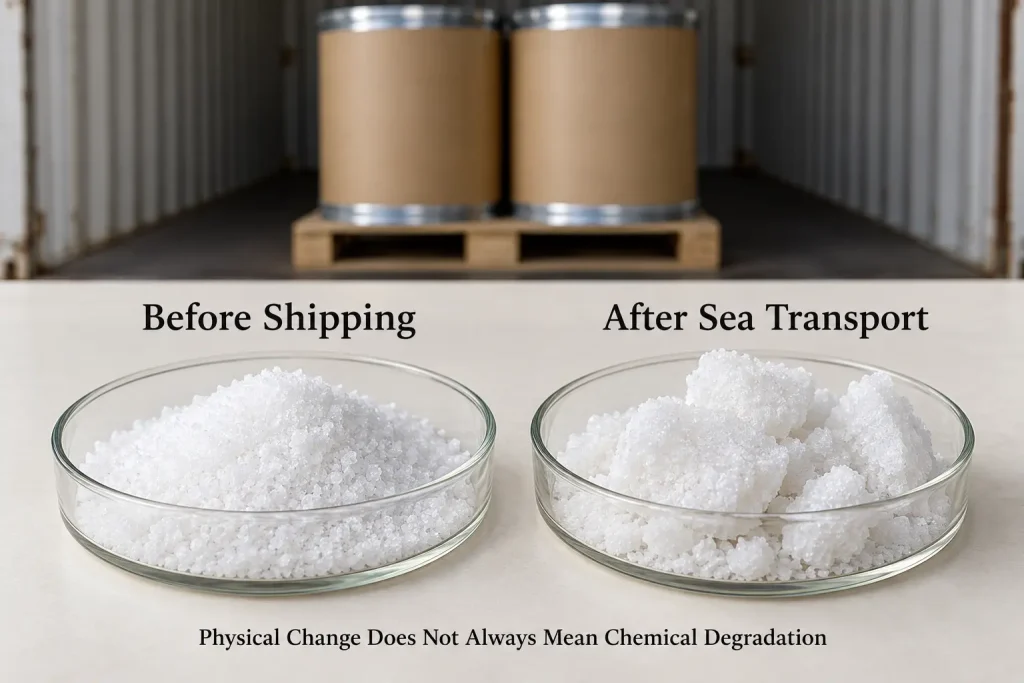
When the first drum is opened, the material does not look exactly as expected. The powder appears more compact. Some crystals have formed small lumps. In another drum, the crystal size looks slightly different from the pre-shipment sample.
Does this mean the product has deteriorated?
Not necessarily.
International transportation is not a continuation of warehouse storage. During a long sea voyage, chemical raw materials may experience changing temperatures, high humidity around the container, continuous vibration, stacking pressure and multiple loading and unloading operations.
Some of these conditions can change the physical appearance of a material without changing its chemical identity. Other changes, however, may indicate damaged packaging, moisture exposure, contamination or actual degradation.
The important question is not simply, “Does it look different?” It is, “What changed, why did it change, and does the material still meet the agreed specification?”
A Chemical Drum Is Not Travelling in a Controlled Laboratory
Products stored in a factory warehouse are usually kept under relatively stable conditions. A shipping container is a very different environment.
During transportation, a container may remain under direct sunlight at a port, travel through regions with different climates and cool down significantly at night. It may then be moved between a truck, terminal, vessel and warehouse.
The product inside a sealed drum is therefore exposed to a series of external temperature cycles rather than one constant temperature.
The packaging protects the material from direct contact with the environment, but it cannot always prevent the product temperature from changing. How the material responds depends on its melting point, crystal form, particle size, moisture sensitivity and packaging method.
1. Temperature Changes Can Alter Physical Appearance
Heat is one of the most important factors affecting chemicals during transport.
If the temperature inside the container approaches the softening or melting range of a product, some of the material may soften, partially melt or become sticky. When the container cools again, the product may recrystallize.
After recrystallization, the material may show:
- Larger or less uniform crystals
- A harder surface layer
- Material attached to the inner liner
- Partial caking or compacted blocks
- A different crystal appearance from the original sample
These changes do not automatically mean that the chemical composition has changed. A product may retain the correct identity and assay after melting and recrystallization.
However, the material should still be evaluated before use. Physical changes may affect weighing, dissolution, feeding, filtration or other processing steps, even when the analytical purity remains acceptable.
2. Humidity Can Become a Problem When Packaging Is Compromised
High humidity outside a chemical drum does not necessarily mean that moisture will enter the product. Properly selected and sealed packaging should provide an effective barrier.
Problems may occur when:
- The inner liner is not properly sealed
- The drum lid becomes loose
- Packaging is punctured during handling
- A closure is opened during inspection and not resealed correctly
- The packaging material is unsuitable for the product
- Condensation forms around a damaged opening
Moisture-sensitive powders may absorb water and become sticky or lumpy. Increased moisture may also affect dissolution, reaction efficiency or storage stability.
For this reason, visible caking should not immediately be classified as either normal or unacceptable. The packaging condition and moisture result should be checked together.
3. Continuous Vibration Can Compact Powders and Crystals
A product may spend weeks being exposed to low-level vibration from trucks, cranes, terminals and vessel movement.
Over time, vibration allows smaller particles to move into the gaps between larger particles. The material gradually settles and becomes more compact. Stacking pressure can increase this effect, especially near the bottom of a drum or bag.
As a result, the product may occupy less volume or appear denser when opened.
This does not necessarily mean that product weight has been lost or that the material has chemically degraded. It may simply be a change in bulk density and particle arrangement.
However, severe compaction can still create practical problems. Operators may find the material harder to discharge, break apart or feed into production equipment. The customer should therefore evaluate both chemical quality and process usability.
4. Crystal Size Can Change Without Changing Chemical Identity
Crystalline chemicals do not always maintain exactly the same visible crystal form throughout transportation.
Heating, cooling, pressure and localized softening can affect crystal size and distribution. Fine crystals may form larger aggregates, while compacted material may look very different from the supplier’s retained sample.
A visual comparison is useful, but it is not enough to determine whether the batch is acceptable.
Depending on the product and agreed specification, the evaluation may include:
- Product identity
- Assay or purity
- Moisture content
- Melting range
- Color
- Relevant impurities
- Solubility or dissolution behavior
- Particle size, where it affects the process
The appropriate tests depend on the material and its intended application.
Physical Change or Quality Failure?
One of the most common mistakes in international chemical trade is reaching a conclusion based only on photographs.
A photograph can document the condition of the product, but it cannot confirm chemical identity, purity, moisture or impurity levels.
Some appearance changes may be mainly physical:
- Light caking that breaks apart easily
- Settling or increased compaction
- Changes in crystal size
- Powder attached to the inner liner
- Recrystallization after temperature cycling
Other signs require more careful investigation:
- Broken seals or damaged packaging
- Visible water inside the package
- Leakage
- Foreign particles
- Strong or unusual odor
- Significant and unexpected discoloration
- Labels that do not match the documents
- Abnormal analytical results
Even when a change appears to be physical, the material should not be released for production until the buyer has completed the necessary inspection and testing.
What Should Buyers Do When a Shipment Arrives?
A structured receiving procedure helps both the buyer and supplier identify problems more accurately.
Check the packaging before opening
Inspect the drum, bag, seal, pallet and external labels. Photograph any dents, punctures, leakage or water marks before moving or opening the package.
Confirm the shipment information
Compare the product name, batch number, quantity and packaging information with the purchase order, packing list and Certificate of Analysis.
Record the product condition
Take clear photographs of the material under neutral lighting. Record whether the product is loose, compacted, caked, discolored or attached to the inner liner.
Take a representative sample
Sampling should follow the customer’s approved procedure. A sample taken only from the surface may not represent the entire package, particularly when the material has settled during transportation.
Test against the agreed specification
The required items may include identity, assay, moisture, melting range, color or application-related performance. The original specification and agreed analytical methods should be used whenever possible.
Contact the supplier with complete information
If an abnormality is found, provide the supplier with the product name, batch number, package number, photographs, storage conditions and test results.
A message saying only “the product looks different” makes technical investigation difficult. Complete information allows both sides to compare the customer’s sample with the supplier’s retained sample and production records.
What Can Suppliers Do Before Shipment?
The supplier’s work does not end when the product passes final inspection.
Packaging and documentation are part of product quality during international trade. Before shipment, suppliers should consider:
- Whether the packaging material is compatible with the product
- Whether the inner liner and drum are properly sealed
- Whether the product requires protection from moisture, heat or light
- Whether palletization is strong enough for repeated handling
- Whether labels remain clear throughout transportation
- Whether a representative retain sample has been stored
- Whether batch documents can be traced quickly if a complaint occurs
The packaging method should be selected according to the specific product rather than applied identically to every chemical.
Communication Is Part of Quality Control
When a shipment arrives with an unexpected appearance, the situation can easily become emotional. The buyer may believe the product is defective, while the supplier may assume the change is harmless.
Neither conclusion should be made without evidence.
A better approach is to separate three questions:
- Has the physical appearance changed?
- Does the material still meet the agreed analytical specification?
- Will the physical condition affect the customer’s production process?
A product may pass chemical testing but still require additional handling before use. Alternatively, a material may look normal but fail an important analytical item.
Quality evaluation therefore requires visual inspection, analytical testing and application understanding—not only one of them.
Final Thoughts
A chemical product can experience a surprisingly complex journey between the factory and the customer’s warehouse.
Heat, cooling, humidity, vibration and pressure may change the way a powder or crystal looks. Some changes are mainly physical, while others may indicate packaging failure or chemical deterioration.
The safest response is neither immediate rejection nor automatic acceptance.
Buyers should document the condition, inspect the packaging, take a representative sample and test the material against the agreed specification. Suppliers should provide suitable packaging, traceable batch documentation and timely technical support.
When both sides use evidence rather than appearance alone, transportation-related issues can be identified more quickly and handled more fairly.
Zaoyang Cixiang Pharmtech supplies cinnamic-series products and related fine chemical materials to international customers. We support product documentation, sample evaluation and communication throughout the purchasing and delivery process.