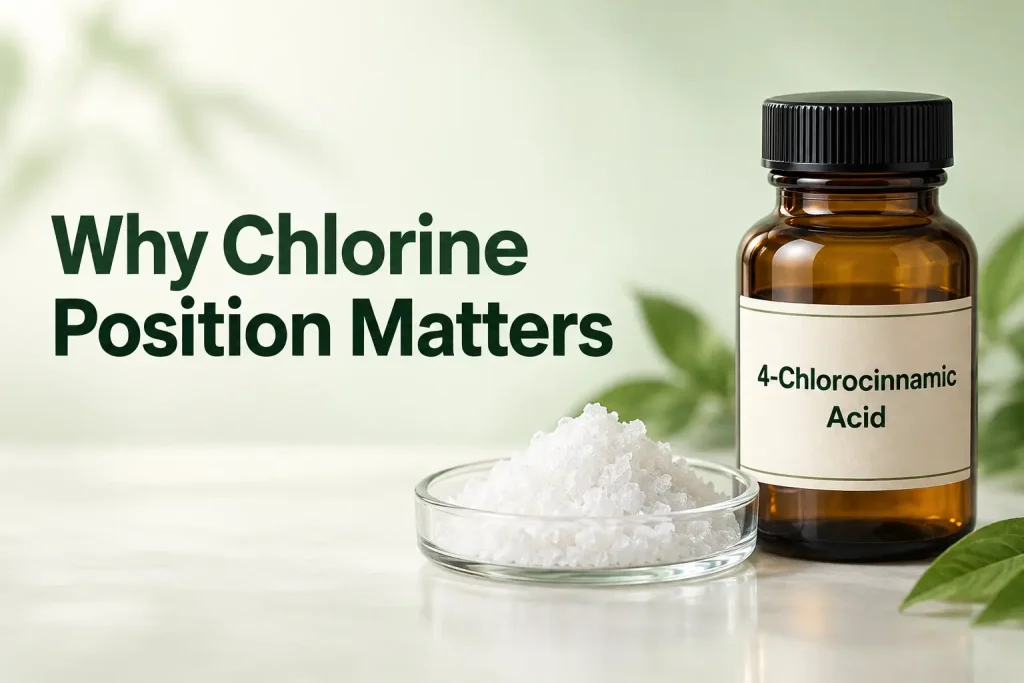
In fine chemical synthesis, a small structural change is rarely just a small detail.
Consider cinnamic acid and 4-chlorocinnamic acid. Their structures share the same aromatic ring, carbon–carbon double bond and carboxylic acid group. The visible difference is a chlorine atom positioned opposite the side chain on the benzene ring. On paper, it looks like a modest modification. In a real synthesis route, however, that chlorine atom gives the molecule a different identity and can influence how the intermediate is selected, analyzed and used.
This is why buyers and R&D teams should look beyond similar product names and confirm the exact substitution pattern before moving from sample evaluation to bulk purchasing.
What Is 4-Chlorocinnamic Acid?
4-Chlorocinnamic acid, also called p-chlorocinnamic acid, is a chlorinated derivative of cinnamic acid.
- CAS No.: 1615-02-7
- Molecular formula: C₉H₇ClO₂
- Molecular weight: approximately 182.6 g/mol
- Typical appearance: crystalline solid
- General role: organic synthesis intermediate
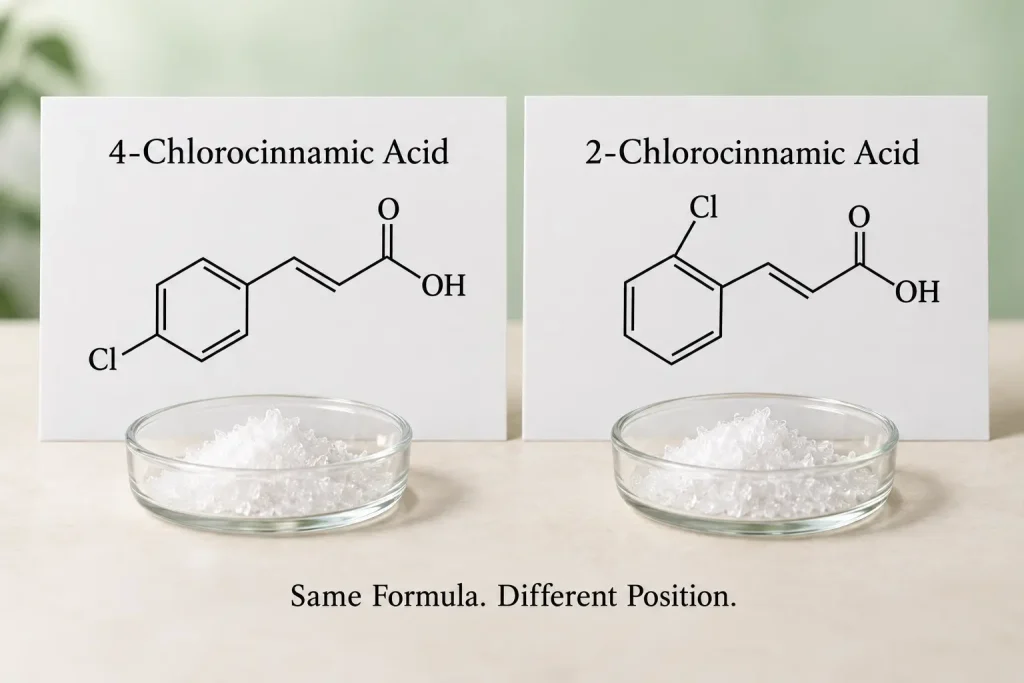
The number “4” identifies the location of the chlorine atom on the aromatic ring. It is positioned at the para position relative to the cinnamic acid side chain. This molecular “address” is important because 2-chlorocinnamic acid and 4-chlorocinnamic acid are positional isomers: they have the same molecular formula and molecular weight, but their atoms are arranged differently.
They should therefore be treated as different raw materials, not as alternative names for the same product.
Why Can the Position of One Chlorine Atom Matter?
The behavior of an organic molecule depends not only on which functional groups it contains, but also on where those groups are located.
In 4-chlorocinnamic acid, the chlorine atom is located across the aromatic ring from the side chain. Compared with an ortho-substituted structure, this arrangement creates a different electronic and steric environment. Those differences may influence crystal packing, physical properties, analytical results and the way the molecule behaves in a downstream synthesis route.
This does not mean that one positional isomer is universally “better” than another. The correct choice depends on the target molecule and the reaction pathway designed by the customer.
For a project that specifically requires a para-chloro aromatic structure, using the ortho isomer would not simply create a minor variation. It would introduce the wrong molecular building block and lead toward a different downstream product.
More Than a Product Name: A Practical Selection Scenario
Imagine that a development team is sourcing a chlorinated cinnamic acid for a new fine chemical intermediate. The purchasing request says only “chlorocinnamic acid.”
That description is not specific enough.
Both 2-chlorocinnamic acid and 4-chlorocinnamic acid may appear as light-colored crystalline materials. They also share the same molecular formula. A purchasing team looking only at the general name or molecular weight could therefore select the wrong product.
A reliable evaluation should begin with three questions:
- Which chlorine position is required by the synthesis route?
- Does the CAS number match the intended structure?
- How will the laboratory confirm positional identity before scale-up?
Chromatographic and spectroscopic methods may be used as appropriate to the customer’s analytical procedure. The important point is that a general purity result alone cannot replace identity confirmation. A material can show a high assay and still be the wrong positional isomer for the project.
Where Does 4-Chlorocinnamic Acid Fit in a Synthesis Route?
4-Chlorocinnamic acid is mainly valued as a building block for further organic synthesis. Its structure offers several features that may be used in route development: a para-substituted aromatic ring, an unsaturated carbon–carbon bond and a carboxylic acid group.
Depending on the intended product and reaction design, downstream work may involve transformation of the carboxylic acid group, modification of the double bond or retention of the para-chloro aromatic structure in a more complex intermediate.
The practical value of the material therefore lies less in a direct end-use function and more in the specific structure it contributes to the next synthesis stage.
This also explains why application information should always be discussed in the context of a defined route. A raw material that performs well in one synthesis may require different controls in another process because solvent systems, catalysts, temperatures and impurity tolerances are different.
What Should Buyers Evaluate Beyond Assay?
Assay is important, but it is only one part of raw-material evaluation.
1. Exact identity
Confirm the full product name, structural position and CAS No. 1615-02-7. Avoid relying on the shortened term “chlorocinnamic acid” in purchase orders and internal records.
2. Relevant impurity profile
The total purity result does not always show which impurities are present. Where relevant to the project, buyers should discuss positional isomers, residual starting materials, reaction by-products and residual solvents with the supplier.
3. Physical consistency
Appearance and melting behavior can provide useful supporting information when checking batch consistency. They should be considered together with identity and assay results rather than used as the only acceptance criteria.
4. Performance in the customer’s process
A representative sample should be evaluated under the intended reaction conditions. Conversion, selectivity, filtration, crystallization and final-product quality may all be more informative than a specification sheet viewed in isolation.
5. Agreed specifications before scale-up
The most useful specification is one connected to the actual project. Before placing a bulk order, the supplier and buyer should confirm the required test items, analytical methods and acceptance limits.
Why Sample Testing Still Matters
Two batches can both meet a general commercial specification and still behave differently in a sensitive downstream process. This may result from differences in trace impurities, particle characteristics, moisture exposure or process-specific compatibility.
Sample testing gives the customer an opportunity to check the material under realistic conditions before committing to production scale. It also allows technical and purchasing teams to identify which parameters genuinely affect the process and include them in future supply agreements.
For specialty intermediates, this step is not unnecessary delay. It is part of responsible scale-up.
Storage and Handling Considerations
4-Chlorocinnamic acid should be kept in properly sealed packaging and protected from contamination, unnecessary heat and moisture exposure. Storage and handling must follow the supplier’s current Safety Data Sheet and the customer’s internal chemical-management procedures.
When receiving a shipment, users should check package integrity, batch identification and accompanying quality documents before opening or sampling the material.
Final Thoughts
The chlorine atom in 4-chlorocinnamic acid occupies only one position on the molecular structure, but that position defines the product.
For R&D and purchasing teams, correct sourcing begins with more than matching a familiar chemical name. It requires confirmation of the exact isomer, CAS number, quality specification and performance in the intended synthesis route.
By treating molecular identity and application testing as part of the same evaluation process, manufacturers can reduce avoidable sourcing errors and build a more reliable path from laboratory sample to bulk production.
Zaoyang Cixiang Pharmtech supplies 4-chlorocinnamic acid and a range of related cinnamic-series intermediates for international customers. For product specifications, samples or project-specific quality requirements, please contact our team.