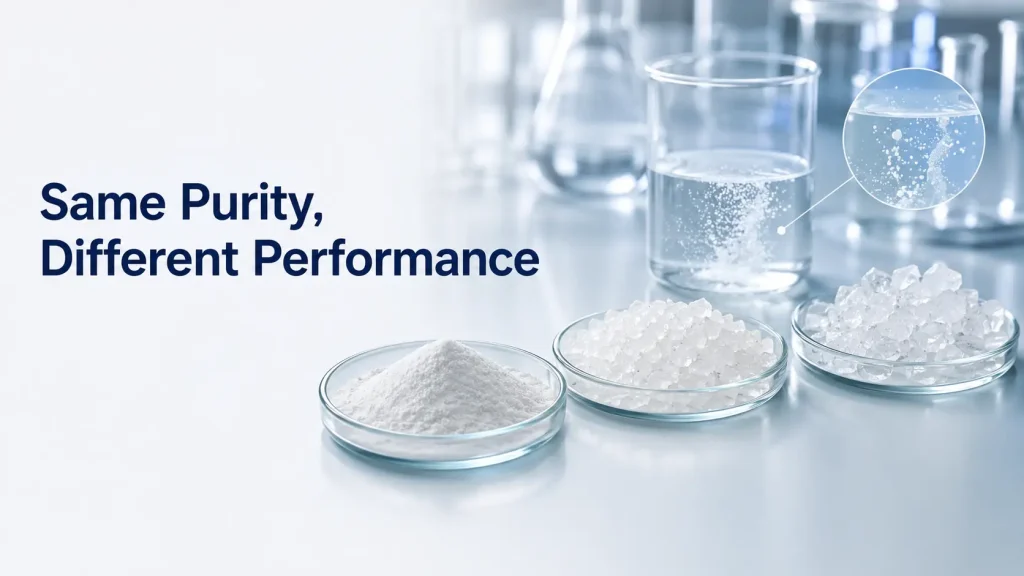
Two batches of a chemical intermediate may have the same product name, the same assay and almost identical COAs—yet behave differently during production.
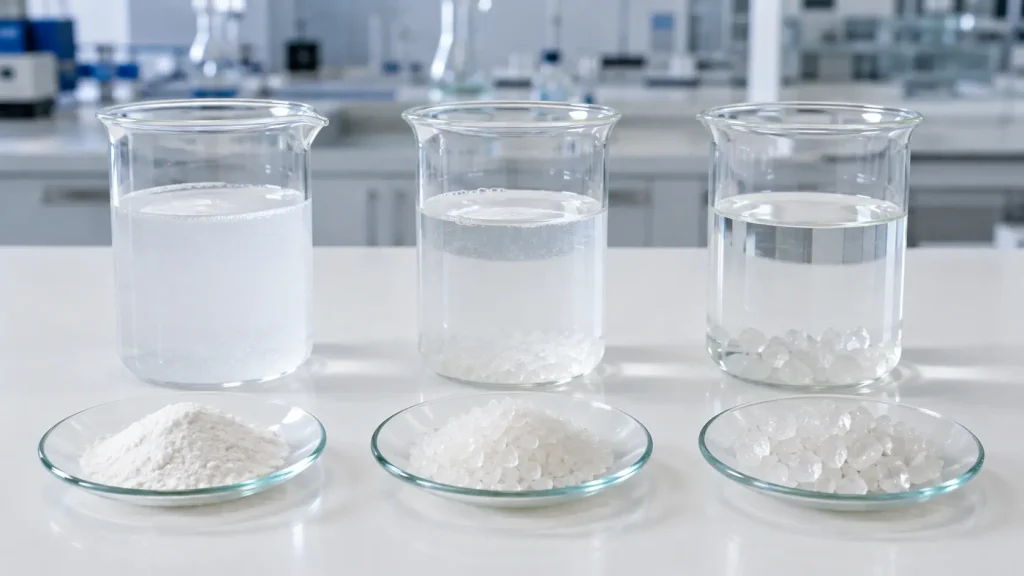
One batch dissolves quickly and produces a clear solution. Another takes longer to dissolve, forms lumps or requires additional mixing. In some cases, the difference is not caused by chemical purity at all.
It may be related to particle size and physical form.
Particle size is sometimes treated as a minor appearance issue. In reality, it can influence how a solid material dissolves, flows, disperses, reacts and is handled in production. Understanding when it matters can help buyers investigate process variations that cannot be explained by assay alone.
Purity Describes Composition—Not Physical Behavior
An assay result tells the buyer how much of the target substance is present according to a particular analytical method. It does not fully describe how the material will behave when it is charged into a reactor.
A solid chemical intermediate can be supplied as fine powder, small crystals, coarse crystals, flakes or fused material. These forms may all meet the same chemical specification, but they do not necessarily have the same surface area, bulk density or flow characteristics.
This is why “same purity” does not always mean “same processing performance.”
When a process involves rapid dissolution, limited mixing time, automatic feeding or a heterogeneous reaction, physical properties may become especially important.
Smaller Particles Usually Dissolve Faster
Dissolution begins at the surface of a solid particle.
When the same mass of material is divided into smaller particles, its total exposed surface area generally increases. More surface can come into contact with the solvent at the same time, which often increases the dissolution rate.
This can affect production in several ways.
A fine material may dissolve more quickly during charging, helping the batch reach a uniform concentration sooner. Larger crystals or agglomerates may require more time, stronger agitation or a higher temperature to achieve the same result.
If the next reaction begins before the raw material has completely dissolved, the apparent reaction rate may also change. What looks like a chemical reactivity problem may actually be a mass-transfer or dissolution problem.
However, smaller is not automatically better.
Very fine powders can agglomerate when they are difficult to wet. Instead of dispersing evenly, they may float on the solvent surface or form compact lumps with a wet outer layer and a dry center. The actual dissolution behavior therefore depends on particle size, wetting, solvent choice, agitation and charging method together.
Particle Size Can Affect Reaction Consistency
In a fully homogeneous reaction, particle size may become less important after the material has completely dissolved.
In a slurry or heterogeneous reaction, however, solid particles may remain present during part or all of the process. Their size can then influence the available reaction surface and the rate at which material transfers between the solid and liquid phases.
Consider two batches with the same assay:
- Batch A consists mainly of small, relatively uniform particles.
- Batch B contains a mixture of fine powder, large crystals and agglomerates.
Batch B may dissolve or react less uniformly because different particles behave at different rates. This can create variation during reaction monitoring, sampling or endpoint determination.
Particle-size differences do not always change the final result, but they may affect how long the process takes and how easily it can be controlled.
This becomes more noticeable when the production window is narrow or when the process has been optimized around a particular physical form.
Flowability Matters During Charging
Particle size also influences how a powder moves through bags, drums, funnels, feeders and transfer systems.
Coarse, free-flowing crystals may be easier to pour but slower to dissolve. Fine powder may dissolve quickly but create dust, cling to equipment surfaces or flow irregularly. A broad distribution containing both coarse and fine material may separate during transport or vibration.
Other properties are involved as well, including particle shape, surface roughness, electrostatic behavior, moisture content and bulk density. Particle size should therefore not be evaluated in isolation.
For manual charging, poor flow may result in material remaining inside the package or forming bridges in a funnel. For automated dosing, inconsistent flow can affect feeding accuracy and charging time.
These problems may not appear during laboratory trials using a small quantity. They often become more visible after scale-up.
Why Packaging Can Change What the Customer Receives
Particle size is created during manufacturing, crystallization, drying, milling or sieving—but it can also change during storage and transportation.
Crystals may break into smaller particles because of vibration and repeated handling. Fine particles may compact into harder agglomerates under pressure. Moisture exposure can promote caking, especially when the material or its impurities are hygroscopic.
Temperature changes may also soften or partially fuse materials with a relatively low melting range.
As a result, the material arriving at the customer’s facility may not have exactly the same physical form it had immediately after production.
Appropriate packaging, fill weight and storage conditions can help reduce these changes. The package should also be suitable for the material’s moisture sensitivity, corrosivity and other hazards described in its SDS.
Common Process Problems That May Be Related to Particle Size
| Production Observation | Possible Physical Cause | What to Review |
|---|---|---|
| Material takes longer to dissolve | Larger particles or hard agglomerates | Particle distribution, agitation and charging order |
| Powder floats or forms lumps | Fine particles with poor wetting | Solvent contact, dispersion method and agglomeration |
| Feeding rate is inconsistent | Poor flow or variable bulk density | Particle shape, fines content and feeder suitability |
| Excessive dust appears during charging | High proportion of fine particles | Handling controls, packaging and ventilation |
| Reaction starts more slowly than expected | Dissolution or mass transfer is limiting | Dissolution time and physical form before reaction |
| Material cakes during storage | Compaction, moisture or temperature exposure | Packaging integrity and storage history |
These observations do not prove that particle size is the cause. Solvent quality, temperature, agitation, moisture, impurity profile and equipment design may produce similar effects.
The table should therefore be used as an investigation guide rather than a final diagnosis.
Does Every Chemical Need a Particle-Size Specification?
No.
Adding a particle-size limit to every product specification can create unnecessary testing and manufacturing restrictions without improving process performance.
Particle size is most useful as a controlled attribute when there is evidence that it affects the customer’s process. Examples may include:
- The material must dissolve within a limited time
- The reaction remains heterogeneous
- Automated feeding requires consistent powder flow
- Excessive fines create handling problems
- Different batches show unexplained differences during charging or reaction
- The customer requires a particular physical form for downstream processing
If the material dissolves completely before a critical process step and minor variations do not affect production, a strict particle-size specification may provide little additional value.
The correct question is not simply, “What is the particle size?”
It is:
“Does particle size influence a process outcome that matters to the customer?”
How Buyers Can Evaluate Physical Consistency
When physical form may affect production, buyers should compare more than one batch.
Photographs can provide a basic visual record, but appearance alone is not enough. Depending on the application, useful information may include sieve results, laser-diffraction data, bulk density, flow observations or a defined description such as powder, crystals or flakes.
Laboratory testing should also reproduce the intended charging and dissolution conditions as closely as practical. A material that dissolves easily in a small beaker may behave differently when added rapidly to a production reactor.
If a problem occurs, recording the batch number, storage history, charging time, solvent temperature, agitation speed and dissolution time can help distinguish a raw-material issue from a process issue.
Supplier and customer can then determine whether the standard specification is sufficient or whether an additional physical control is justified.
Final Thoughts
Chemical purity remains essential, but it is only one part of raw-material performance.
For solid fine chemical intermediates, particle size and physical form may influence dissolution, mixing, reaction rate, feeding, dust generation and scale-up consistency. At the same time, smaller particles are not always superior, and not every process requires a strict particle-size limit.
The most effective specification is one based on actual process needs.
At Cixiang Pharmtech, we welcome technical discussions about the intended use of cinnamon-series intermediates. If physical form, dissolution behavior or charging performance is important to your process, sharing these requirements before sampling can help both sides evaluate the material more effectively.