
When purchasing chemical raw materials, the Certificate of Analysis is one of the most important documents used to evaluate product quality. It can help buyers confirm whether the correct material has been supplied, whether the batch meets the agreed specification and whether its quality is suitable for the intended application.
However, simply checking whether every item says “Pass” or “Conforms” is not enough. A batch may meet the supplier’s general specification but still be unsuitable for a particular synthesis, formulation or production process.
To make a reliable purchasing decision, buyers need to understand the product information, test items, acceptance limits, actual results and analytical methods shown on the COA.
What Is a Certificate of Analysis?
A Certificate of Analysis, commonly abbreviated as COA or CoA, is a batch-specific quality document issued after a material has been tested and reviewed.
A typical COA includes:
- Product name and CAS number
- Product grade
- Batch or lot number
- Manufacturing or testing date
- Test items
- Specifications
- Actual batch results
- Test methods
- Approval or release information
The batch-specific nature of a COA is important. A product specification defines the limits that future batches are expected to meet, while a COA reports the actual results for one particular batch.
A useful COA should clearly connect the material ordered, the batch supplied, the tests performed and the results approved.
COA, Specification, TDS and SDS: What Is the Difference?
Chemical buyers often receive several technical documents that appear similar but serve different purposes.
| Document | Main Purpose | Batch-Specific? |
|---|---|---|
| COA | Reports the test results of a released batch | Yes |
| Product Specification | Defines the required quality limits | No |
| TDS | Describes technical properties and applications | Usually no |
| SDS | Provides hazard, handling and storage information | Usually no |
A COA answers: “What were the quality results for this batch?”
An SDS answers: “What hazards are associated with this material, and how should it be handled safely?”
These documents complement one another, but they are not interchangeable.
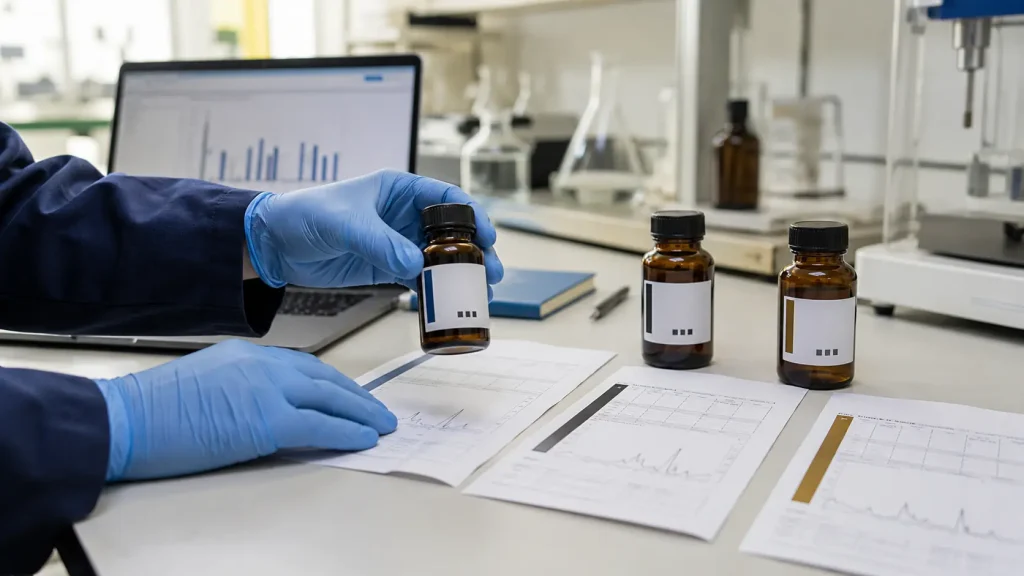
1. Confirm Product Identity and Batch Information
Before reviewing purity or moisture values, confirm that the COA belongs to the material and shipment being evaluated.
The product name, CAS number and grade should match the purchase order and packaging label. The batch number shown on the COA should also match the batch number printed on the product packaging.
Buyers should also check relevant dates, such as the manufacturing date, testing date, release date, retest date or expiry date.
If the batch number does not match, the product identity is incomplete or the COA appears to be a generic template, clarification should be requested before the material is accepted.
Even good analytical results have limited value if they cannot be traced to the actual batch received.
2. Understand the Test, Specification and Result Columns
Most COAs organize quality information into three main columns:
- Test item: The property being evaluated
- Specification: The required acceptance range or limit
- Result: The actual value obtained for the batch
For example:
| Test Item | Specification | Batch Result |
| Assay | NLT 98.0% | 98.7% |
| Water | NMT 0.50% | 0.18% |
| Appearance | Clear, light-yellow liquid | Conforms |
These values are illustrative only. The correct limits depend on the material, grade, application and agreed specification.
Common abbreviations include:
- NLT: Not Less Than
- NMT: Not More Than
- ND: Not Detected
- LOD: Limit of Detection
- LOQ: Limit of Quantification
A result may meet the stated limit but still be close to the acceptance boundary. For example, an assay of 98.1% meets a minimum specification of 98.0%, but it provides less margin than a result closer to the supplier’s normal production level.
3. Review Assay or Purity Carefully
Assay or purity is often the first result buyers compare. However, a higher number does not automatically mean better quality or better suitability.
The analytical method and reporting basis must also be considered. Purity may be reported as an area percentage, mass fraction, dry-basis result, as-is result or content calculated against a reference standard.
Therefore, two suppliers reporting a purity of 99.0% may not necessarily be measuring the product in exactly the same way.
Before comparing results, buyers should confirm:
- Which analytical method was used
- Which units and calculation basis apply
- Whether the result was corrected for moisture
- Whether the method measures the target compound specifically
- Whether the supplier’s method is comparable with the buyer’s method
Small differences between supplier and customer test results do not always indicate a quality problem. Sample preparation, instrument conditions, reference standards and calculation rules can all affect the final value.
4. Check Impurities and Residual Solvents
Overall purity does not provide a complete picture of the impurity profile. Two batches may have the same assay but contain different individual impurities.
Depending on the product and application, a COA may include:
- Individual and total impurities
- Residual starting materials
- Reaction by-products
- Isomers
- Residual solvents
- Elemental impurities or heavy metals
Buyers should pay particular attention to impurities that may affect their process. A trace component can influence reaction selectivity, catalyst performance, color, odor, stability or purification even when the total impurity level remains within specification.
The term “ND,” or “Not Detected,” should also be interpreted carefully. It does not necessarily mean that a substance is completely absent. It means that the amount was below the detection or reporting limit of the analytical method.
If a particular impurity is critical, buyers should confirm the detection limit supporting the ND result.
5. Evaluate Moisture and Physical Properties
Water content can affect chemical stability, reaction yield, crystallization, storage behavior and hydrolysis risk.
A COA may report water content using Karl Fischer titration or use loss on drying. These tests are not automatically equivalent. Karl Fischer titration is intended to measure water specifically, while loss on drying may include water and other volatile substances.
For moisture-sensitive applications, buyers should confirm whether the test method and maximum limit are suitable for their process.
Other physical tests may include appearance, color, melting point, density, refractive index, pH, solubility or particle size.
Unexpected color, turbidity, crystallization, sediment or phase separation may indicate changes in composition, storage conditions or handling history. Qualitative results such as “Conforms” are most useful when the specification provides a clear acceptance description.
6. Check Test Methods, Units and Approval Information
A numerical result is easier to evaluate when the COA identifies the test method, units and calculation basis.
The method may be based on a recognized standard, pharmacopeial procedure, customer-agreed method or validated internal method. An internal method is not automatically inferior, but additional information may be needed when the result is critical to product performance.
Buyers should also confirm that the COA has been reviewed and released through the supplier’s quality system. This may be shown through an authorized signature, approval date, electronic authorization statement or document number.
Missing pages, inconsistent units, unexplained corrections or conflicting dates should be clarified before the batch is approved.
“Conforms” Does Not Always Mean “Suitable”
A COA confirms whether a batch meets the specification used by the supplier for release. It does not prove that the specification is suitable for every customer’s process.
For example, a material may meet the supplier’s general assay and moisture limits but still contain too much water for a highly moisture-sensitive reaction.
The purchasing question should therefore not only be:
“Does this batch pass?”
Buyers should also ask:
“Does this specification control the quality attributes that are important to our application?”
Critical quality requirements, test methods and documentation expectations should ideally be agreed with the supplier before the first bulk order.
Using COAs to Evaluate Supplier Consistency
One COA provides information about one batch. Comparing several COAs can provide a clearer view of long-term supply consistency.
Buyers can review variations in assay, moisture, color, physical properties and critical impurity levels across multiple batches. Results repeatedly close to an acceptance limit may require further discussion.
Supplier qualification should also extend beyond document review. Representative samples can be tested in the buyer’s laboratory or production process to confirm whether the material performs as expected.
For critical applications, change-notification agreements, periodic verification and supplier audits may also be appropriate.
Common COA Warning Signs
Buyers should request clarification if a COA contains any of the following issues:
- No batch number or a number that does not match the packaging
- Product name, CAS number or grade inconsistent with the order
- Numerical test items reported only as “Pass”
- Missing units or unclear calculation basis
- No identifiable test method
- Limits different from the agreed specification
- No release date or approval information
- A generic document not connected to the supplied batch
- Important application-specific quality parameters missing
An unusual detail does not always indicate a quality problem. However, unresolved inconsistencies make it more difficult to reach a reliable acceptance decision.
A Practical COA Review Process
A practical review can be completed in five steps.
Step 1: Confirm Product and Batch Identity
Match the product name, CAS number, grade and batch number with the purchase order, packaging and shipping documents.
Step 2: Confirm the Specification
Check whether the acceptance limits are consistent with the specification agreed between the supplier and buyer.
Step 3: Review the Actual Results
Examine the numerical values, units, test methods and distance from critical limits. Do not rely only on “Pass” or “Conforms.”
Step 4: Compare with Application Requirements
Determine whether the COA controls the quality attributes that are important to the intended synthesis, formulation or manufacturing process.
Step 5: Verify Release Information
Confirm that the document has been reviewed and approved, then retain it with the relevant receiving and traceability records.
Final Thoughts
A Certificate of Analysis is more than a document showing whether a batch has passed inspection. When reviewed correctly, it helps buyers confirm material identity, evaluate batch quality, identify potential risks and compare supplier consistency.
For cinnamon-series products and other fine chemical intermediates, chemical identity, assay, impurity profile, moisture, appearance and physical form may all influence downstream performance.
At Cixiang Pharmtech, we welcome technical discussions before sampling or bulk purchasing. If you are evaluating a cinnamon-series product, share your target specification, intended application and documentation requirements with our team so that product and quality expectations can be aligned from the beginning.